
THE GEOLOGY BENEATH OUR FEET: Curtis Arboretum
Prepared by the Philadelphia Mineralogical Society
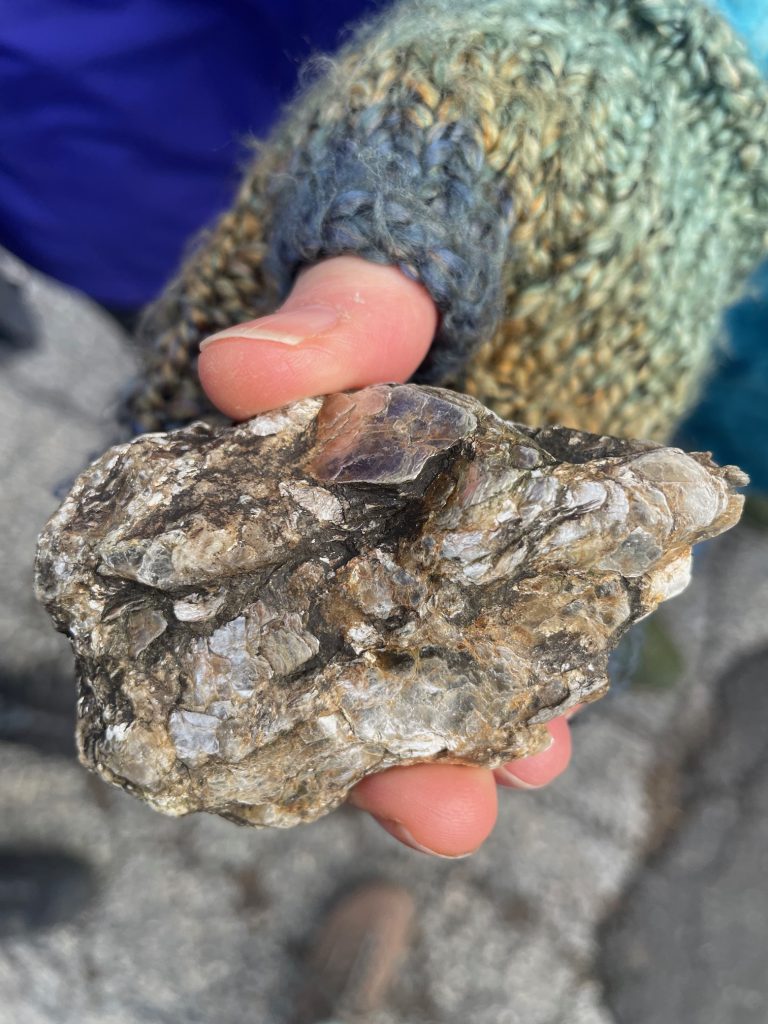
Beneath the beautiful Curtis Arboretum lies an ancient rock type called the Wissahickon formation. This ancient body of rock stretches from the Delaware River, through southeastern Pennsylvania (including the Philadelphia area), and out all the way to eastern Maryland. The predominant rock found is mica schist (often referred to as the “Wissahickon schist”) whose primary mineral is silvery, wavy, layered muscovite mica, which can be seen on rock faces throughout the Arboretum. Other minerals frequently mixed with the mica are quartz, kyanite/sillimanite, and feldspar, which can be difficult to see on the surface, but which can be seen as whitish minerals mixed with the mica on the fractured ends when a piece is broken.
About 400 million years ago, the Wissahickon formation began as sediment composed of mud, sand, silt eroded from even older rock formations, and some decaying plants and animals. This sediment was gradually buried very deeply and exposed to incredibly high temperature and pressure. This heat and high pressure first changed the loose sediment into sedimentary rock, mainly shale with some layers of sand becoming sandstone. Over millions of years, the extreme conditions next changed shale and sandstone into the metamorphic rocks slate and quartzite respectively. Over time, the slate went through another metamorphic change, becoming the mica schist with some lighter colored bands of quartzite or quartz that we see today. And even the mica schist can change with heat and pressure to become gneiss (pronounced “nice”), which is seen as a hard, granite-like black and white banded rock, much less common in the Arboretum than the mica schist.
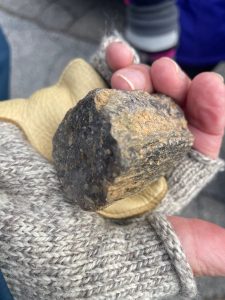
Some of the bands of quartz in the mica schist fused together as they cooled into larger seams or almost tube-like masses of milky/white quartz that can be found throughout the park, especially along Rock Creek. The outside surface of the quartz is often grooved, reflecting the contact with the surrounding layers of mica schist where it formed. Frequently some muscovite mica and rarely garnet crystals remain clinging to the outside of these quartz masses. Some enthusiasts mistake these quartz formations for “petrified wood”, which they somewhat resemble.
From early colonial times until at least the 1940s, mica schist was a common building stone quarried for houses, bridges, and walls throughout southeastern PA. The harder gneiss was also quarried, mainly for building stone and curb stone. This quarrying also opened up these ancient rock formations to easier study of their internal geology and mineralogy.
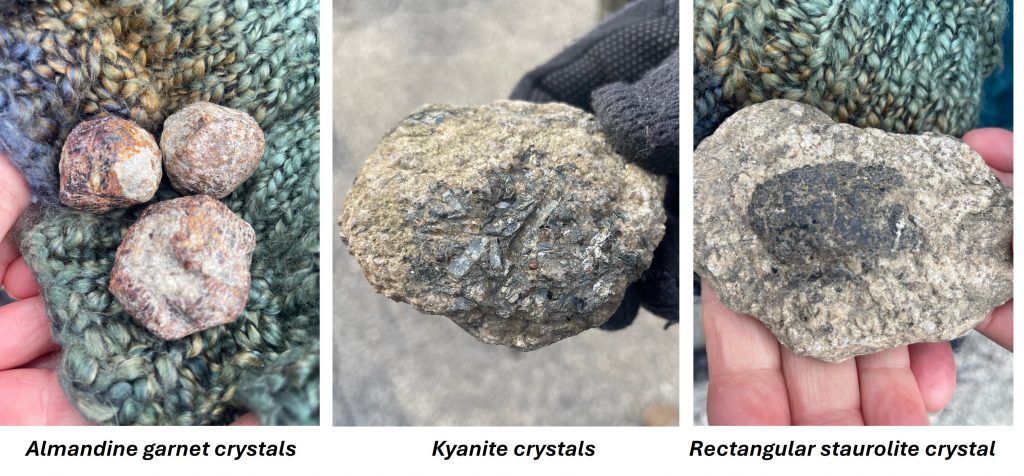
Depending on which additional minerals were also present in the ancient rock as it was altering under high pressure and temperature, we can occasionally find other interesting minerals that crystallized in the mica schist as it cooled. For example, along Rock Creek and its tributaries, rounded, reddish-brown almandine garnet crystals up to 1 inch in diameter and black, rectangular staurolite crystals up to 1” x 0.7” can be found. Both are unusually large crystals for these two minerals anywhere in the Wissahickon formation, suggesting perhaps that in these areas the mica schist cooled more slowly to allow these crystals more time to grow. Much less common are slender, shiny, black schorl tourmaline crystals and small, flat, bluish blades of kyanite crystals.
Over the hundreds of millions of years since the mica schist was formed, movement deep within the earth caused cracks and holes to form at various places in this rock layer. Pushing up through some of the empty spaces in the mica schist was a molten rock that cooled into pegmatite, an igneous rock that in the Arboretum occurs as a white/pink feldspar called microcline and stacked crystals of silvery muscovite mica. The microcline is visible along Rock Creek in sizes varying from small rocks to large boulders. Sometimes the mica has eroded off the surface and may not be easily seen.
Perhaps the most outstanding geological feature in the Arboretum is the large, isolated boulder on the far bank of Rock Creek, partway between the dog park and Washington Lane.
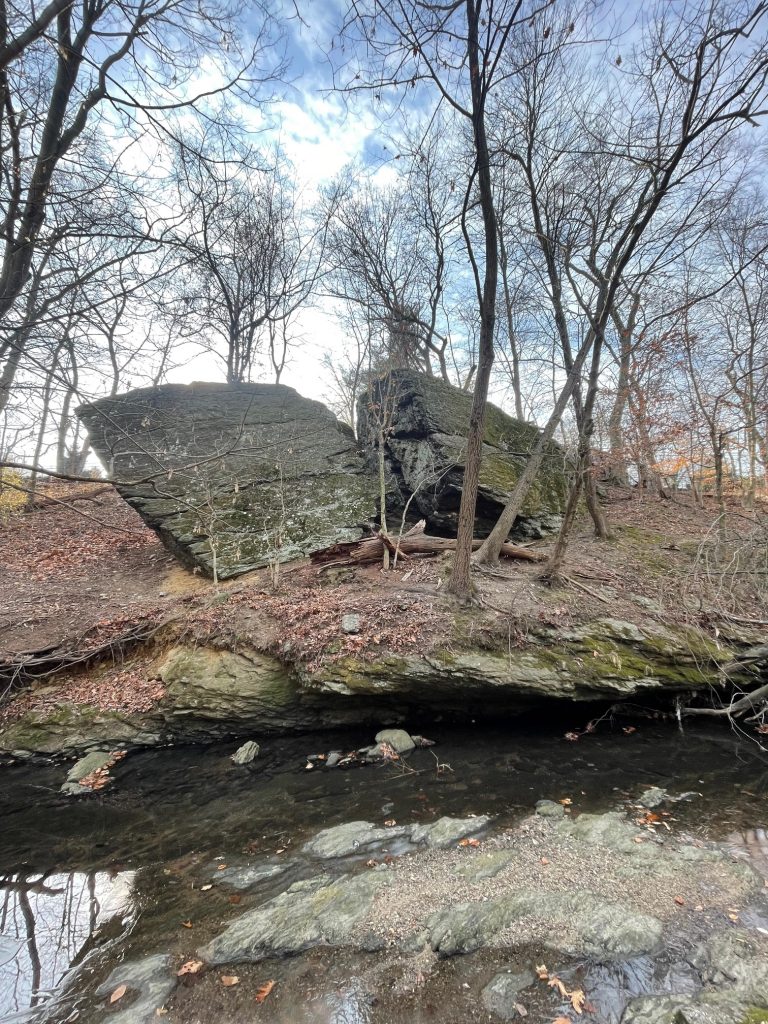
This boulder does not have the smooth, rounded features typical of a glacial erratic; instead, it has straight, rather rough edges on each side, indicating that it broke free from the larger body of mica schist on that side of the creek. Why didn’t it just erode with the rest of the rock originally around it? One possibility is that the mica schist here may contain more internal layers of weathering-resistant quartz than the surrounding rock. Another is that there may have been larger ancient cracks/holes around this boulder that allowed it to break free from the rest of the mica schist around it and avoid faster weathering. Whatever led to its formation, it is impressive!
The beautiful hills, slopes, and valleys of Curtis Arboretum result from the geology beneath the park and the creeks that have cut through it. The geology provides the minerals in the soil that nurture the plants and animals found here. For those curious enough to look, it also provides an interesting array of crystallized minerals. What a treasure!